

Biomass and Nutrients in Biological Wastewater Treatment Plants
 What is biomass (sludge) and what are the ideal ratios between Carbon, Nitrogen, and Phosphorus?
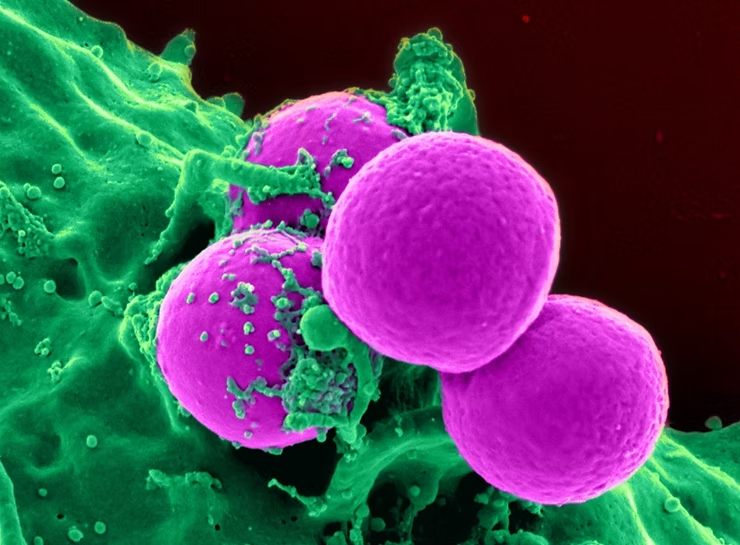
The biomass in a biological wastewater treatment plant (WWTP) consists of a vast population of bacteria. Empirical studies have established a specific ratio between Carbon, Nitrogen, and Phosphorus levels in aerobic systems. While ratios vary slightly depending on the population type, the general rule of thumb is a ratio of 200 ppm Carbon, 30 ppm Nitrogen, and 1 ppm Phosphorus. In other words, for every 1 ppm of Phosphorus, there are 200 ppm of Carbon and 30 ppm of Nitrogen. These ratios are not absolute, and over time, biological organisms can adapt to different C:N:P ratios. However, every population always has a limiting factor. For example, if a biological system is fed 4000 ppm Carbon, 570 ppm Nitrogen, and 20 ppm bioavailable Phosphorus with a long hydraulic retention time, one might assume all COD (Carbon) would be consumed. However, Nitrogen or Phosphorus might limit COD consumption. As seen in this example, the limiting factor is Nitrogen (according to the 200:30:1 ratio cited earlier). In this scenario, after all nutrients are consumed, 200 ppm Carbon and 1 ppm Phosphorus would remain in the solution. A similar phenomenon occurs in real wastewater; only a portion of the COD is consumed, and it is impossible to reach zero COD. One reason for this is a nutrient deficiency. Nutrients are the food source; in agriculture, for instance, nutrients are fertilizers.
What is a limiting factor and how do nutrients balance it?
Nutrients consist of Nitrogen and Phosphorus. There are also additional nutrients known as micronutrients.
Laboratory tests can identify the limiting factor by analyzing which substances remain—Nitrogen, Carbon, or Phosphorus—and in what quantities. To prevent residuals, chemical dosing of nutrients can be applied to balance the system and ensure nutrient availability does not limit consumption. The goal is to achieve the correct ratios described above. Biomass may enter a state of stress when nutrients are not added to balance limiting factors or when the biomass remains in the reactor for too long. In these states, the biomass may die, causing various issues including biomass floating (bulking). Therefore, one must ensure the addition of nutrients or micronutrients to maintain system balance.
What is the correct biomass concentration in a biological facility?
In a biological facility such as an Activated Sludge process, it is important to maintain a biomass concentration of 0.25% to 0.5%. If this ratio is not maintained, the biomass is compromised, and the treatment process may become slower and less efficient.
In an MBR (Membrane Bioreactor) configuration, the reactor is smaller, resulting in shorter retention times, requiring a biomass concentration of approximately 1%.
Biomass concentration can be verified using a laboratory test called MLSS (Mixed Liquor Suspended Solids).
When should biomass be removed from a biological facility?
It is also crucial to ensure regular biomass wasting (removal), as sludge ages, its quality declines, and it becomes susceptible to sludge diseases and mortality. For example, a condition known as "Pink Spot" manifests as yellow or pinkish-white spots.
Occasionally, industrial plants use antibacterial agents that, upon reaching the WWTP, decimate the biomass. Therefore, it is critical to separate these materials at the source to prevent them from reaching the biological system.
Monitoring biomass volume is vital—when settling the liquid from the reactor in a graduated cylinder for 30 minutes (SVI test), ensure that the settled sludge does not exceed 50% of the volume.
If severe biomass issues persist, it is often better to restart the process using municipal sludge, which is typically available for free. Municipal plants are usually happy to provide sludge, and the primary cost is transportation. Before introducing municipal sludge into the facility, it must be screened through a 1mm or 2mm mesh to remove debris such as tomato skins, seeds, etc. The problematic biomass in the facility is drained, and after introducing the new biomass, a process of acclimatization begins, eventually returning the plant to stable operation.