

Ion Exchange Plants
There are many solutions for wastewater treatment, but few allow for the reuse of treated effluent back into the facility's operations.
One such solution is Ion Exchange (IX), which relies on the varying affinity between "charged" ions on a specialized resin and the ions present in the wastewater.
This type of solution is common across a variety of industries, ranging from the metal industry (allowing for the reuse of rinse water or acids as raw materials) to water softening for scale-sensitive processes and as a source for distilled water.
The ion exchange process was first discovered by two British chemists, Thompson & Way, in 1850. They observed that certain types of soil adsorb ammonia (NH4+) from fertilizer solutions, releasing calcium ions (Ca+2) in return.
Since then, the field has advanced significantly, and today, ion exchange is based on selective resins.
Each resin has its own affinity based on its functional group.
Resins are divided into two families:
Cationic Resins – Resins with an affinity for cations (positively charged ions) such as metals and positively charged organic compounds. These adsorb the cations and release H+ ions into the solution.
Anionic Resins – Resins with an affinity for anions (negatively charged ions) such as non-metals and negatively charged organic compounds. These adsorb the anions and release OH- ions into the solution.
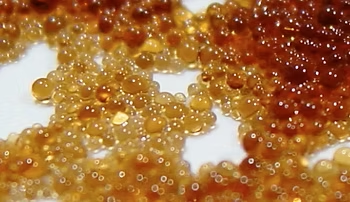
The exchange is carried out by flowing the solution through columns filled with the resin.
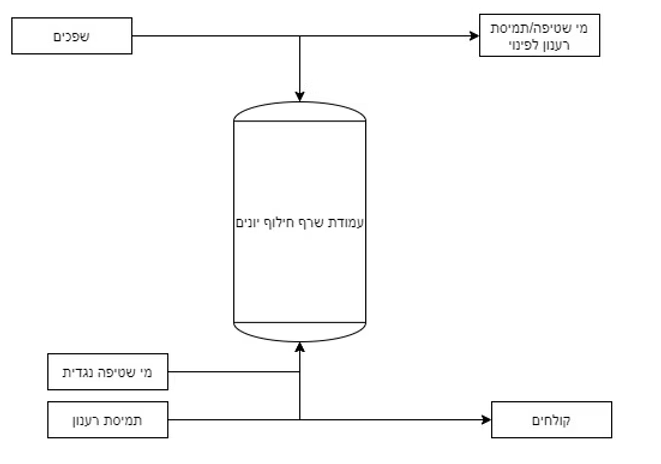
The solution enters the column from the top, passes through the resin, and exits the column once the target ions have been exchanged.
As more wastewater flows through the column, the available exchange sites on the resin decrease until a point is reached where no free sites remain. To reuse the resin, regeneration must be performed.
The regeneration process is carried out in stages:
-
Backwashing with water - To remove wastewater residues from the bed.
-
Regeneration wash - Replacing the ions adsorbed onto the resin with target exchange ions. Each resin has a designated regeneration solution—usually an acid or base at a 10% weight concentration. Some resins require further regeneration with additional solutions.
-
Drying the bed with air
Matching the resin to the solution is key to the correct implementation of ion exchange.
When matching the resin, the following design points must be considered:
- The flow rate of the solution undergoing exchange.
- The size of the ion exchange column.
- The concentration of the exchangeable ions.
- The presence of background ions that may compete for exchange instead of the target ions.
At Greenfield Eco, we will be happy to assist you in establishing an ion exchange plant and selecting the appropriate resin for the correct treatment of your facility's wastewater.